

Carlton
1921–1929
91Games
0Goals

 12
Jim
#12180 cm71 kgFull Back1921, 1923-29
Carlton
1921–1929

Fitzroy
1929
James Hamish “Jimmy” Watson was a resolute full-back who fell just short of playing 100 games of VFL football for Carlton and Fitzroy between 1921 and 1929. Jim was born in 1896 to James Watson (senior) and Mary Brown in Prahran on 11 March 1896. He was 25 years of age when he played his first match for the Navy Blues against St Kilda at Princes Park in May, 1921.
Mary had been deserted by her first husband in 1888 and left with three children to raise. She married James in 1899 after having two children with him before they married, including Jim, and two after. Jim’s birth date had been difficult to find because he was born as James Watson Blyth, the surname carried by his mother from her earlier marriage. Jim contracted it to James Watson and was raised above a shop in Lygon Street just a few blocks from Princes Park.
In his youth he played football for the East Brunswick Presbyterians.
A war in Europe was becoming likely as Jim was ready to take on higher football challenges. In1913 an Infantry Militia was formed to provide military training for youth of the North Carlton districts. Recruits committed for eight years to bear arms for their country as the compulsory reserve army of the nation. Jim signed up as an 18 year old.
He enlisted for Army service on 17 July 1915 as a 19 year old. He was a lightly built youth: 173 cms tall and weighing just 62 kgs.
By mid 1916 he was serving in France and was injured by a gunshot wound to his arm. He was repatriated back to England to recover before rejoining his unit in late 2017. Within a month he was severely gassed and returned to Australia before being discharged in July 1918.
He was now in his 23rd year and one might have thought that he was in no condition to start a football career. However he signed up with the Carlton District team that functioned as a junior grade for the Carlton VFL team. He impressed enough to play four senior games in 1921 but none in 1922.
In 1922 The Sporting Globe wrote a substantial piece about him with the headline “Prominent Junior” and highlighted his versatility. It wrote that:
“The Junior League nourishes no more promising player than Jim Watson, star of the Carlton District team. Watson is recognised as the best all round man in the Junior League at the present time. His versatility stamps him as an ideal type of footballer, and one who could take the place of another man with confidence of doing as well in the position as the absentee”.
“When he returned home (from the war) he was invited to join the Carlton District, and with the juniors he soon made good. He has played with the team for four years and during that time he has had four games with the senior "Blues." In the senior ranks he did not strike form, but it is probable that he will be given another try next season. The value of Watson's play is not realised till it is said that he can take the positions of other men and fill them with success. His place with the team is usually full-back, but where danger threatens he is sent to strengthen the weak lines. His kicks cover great distances and since he uses the left and right methods of propulsion with equal success, he is a decided acquisition to his side. In the opinion of Rod McGregor (a recently retired champion Carlton centreman), Watson is a natural kick with the right or left foot, and the best man he has seen using both feet. He also has a good turn of speed, and while on active service won some important events in military sports. He refrained from competing at home, finding the training for sprint running interfered with his football. His aerial work is well above the ordinary junior standard, and is of great use to him when the position demands him on the forward lines.”
The Globe noted that Jim is a well-built type of man, appearing to have the build of an athlete rather than a footballer. Today we might think of Jim as a natural outside midfielder with a light build, the speed of a sprinter and the ability to kick well on either side. However he spent most games at fullback playing on the key forwards of the day like Syd Coventry and Jack Titus. Maybe his war injuries meant that he did not have the stamina for a midfielder or Carlton needed to fill a gap at fullback.
The Globe went on to say that …. “Jim Watson has had several offers from other clubs to join their ranks but he has remained with the District though Brunswick and Fitzroy have tried to secure his services”.
Jim wore guernsey number 17 on debut and did well, as Carlton comfortably defeated the Saints by four goals. His next two outings – against Fitzroy in round 4, and South Melbourne in round 5 – both finished in draws. After that, Jim didn’t represent the Blues for more than two years – until round 10, 1923; when he pulled on guernsey number 33, and reclaimed his place in the senior side in a dramatic 1-point win over Fitzroy at Princes Park.
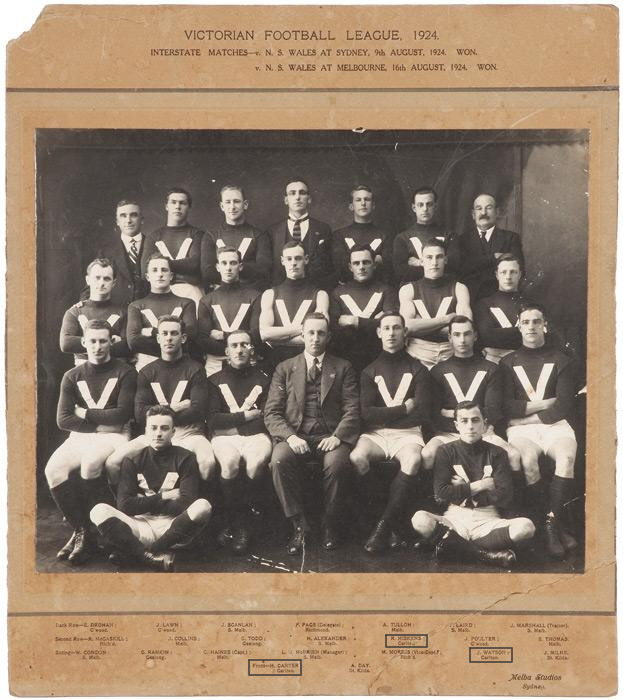
Between 1923 and 1926, the Carlton Football Club enjoyed relatively little success, finishing outside of the top four each year. Still, Watson stuck to his task on the last line of defence, and rarely missed a game. He played well enough to be selected in the 1924 Victorian team that played N.S.W. in Sydney on August 09 and in Melbourne on August 16. The Vics won both matches.
It wasn’t until 1927 that the Blues climbed back into finals contention by finishing fourth – only to run head-on into a Richmond combination approaching their peak. The Tigers began a period of dominance over the Blues by snatching victory in the dying seconds of the 1927 first Semi Final – and compounded the disappointment by doing it again in 1928. A record crowd of 66,381 packed into the MCG that afternoon, to see Watson run ragged by Richmond’s star full-forward Jack Titus, who kicked six goals in a 54-point triumph by the Tigers.
By circumstance, Jim’s next (and last) game for Carlton was also played against Richmond – at Punt Road in round 2, 1929. This time, the Tigers rotated Titus and their clever half-forward Jack McCormack through full-forward, and between them the pair kicked seven goals in a 10-point win to the home side. It’s hard not to surmise that Watson’s confidence was bruised by those experiences, and easy to understand that Jim would feel that it was time to call it a day. Before he could hang up his boots however, Fitzroy threw him a lifeline and Carlton agreed that he could finish off the year at the Brunswick St. oval. His six games with the Maroons in the latter part of 1929 took his career tally of games to 97.
Because he was rarely stationed anywhere else but full-back throughout his career, Watson never kicked a goal at VFL level. Indeed, it is highly probable that he never actually made an attempt.
Jim worked as a cashier and clerk and married Marjory Bray in 1934 after his football career had finished. Marjory had been widowed in the first year of an earlier marriage. They had two sons, one who sadly died as a 13 year old.
The first Blue to wear number 33 on to the field at senior level, Jim Watson passed away at Mentone on December 28, 1978 aged 82 years and 292 days old.
Jim Watson was a valiant servant of the Carlton Football Club who contributed across nearly 100 games though wearing the serious wounds of war service and being required to play in positions that stretched his natural abilities in a team that was struggling to be competitive until his last seasons.
----
With thanks to Ray Kinnear for providing a substantial addition to this profile in March 2026.
Jim Watson was selected in the 1924 Victorian team that played N.S.W. in Sydney August 09, and in Melbourne August 16. The Vics won both matches. Watson seated second from right.
50 Games : Round 12, 1926 vs Hawthorn
Last updated by Club Archive ·